Austin
The Last Thing He Told MeAustin is the city where Hannah and Bailey’s search for Owen’s past shifts from suspicion toward evidence. Its all-night café, university grounds, football stadium, newspaper traces, and active U.S. Marshals office each offer a different kind of clue; together, they make the city less a backdrop than the place where Owen’s assumed life begins to come apart and Bailey finds a name that changes what she knows about her father.
Setting and First Steps
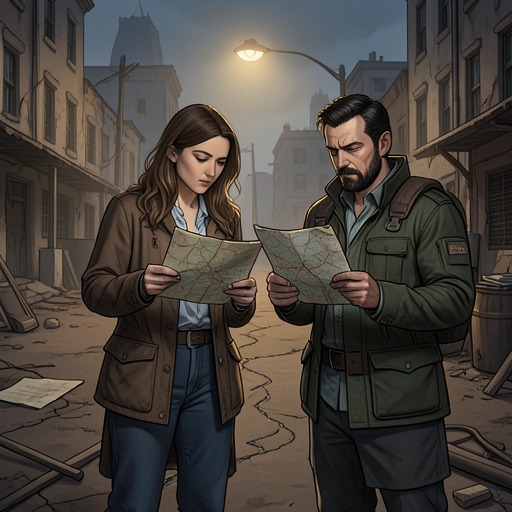
At 12:45 a.m., Magnolia Cafe is still busy: music plays, every booth is taken, and the restaurant’s reputation as an Austin institution for all-night food is borne out by the crowd. Hannah and Bailey order large coffees and gingerbread pancakes, with bananas on the side. Bailey enjoys the pancakes, and watching her eat gives Hannah a brief sense that she is doing something good for her. They sit by the door beneath a flashing red sign, “SORRY WE’RE OPEN,” while Hannah tries to find the words to tell Bailey what Jake has said. The ordinary meal therefore carries an uneasy second purpose: it is a pause in the investigation, but also the setting for a difficult disclosure.
The next important Austin location is the University of Texas at Austin. After taking a cab, Hannah and Bailey arrive at the College of Natural Sciences, whose buildings and surrounding green seem expansive to Hannah in comparison with her own much smaller liberal-arts college. The scale of the campus is concrete, but the scene’s larger significance lies in what it may establish. Tobias Cookman has been on the university faculty for twenty-nine years, and the possibility that Owen once took his class would give Hannah and Bailey their first tangible support for the suspicion that Owen’s account of his life was false. The campus makes the investigation feel closer to an answer, while Hannah recognizes that an answer may lead somewhere neither of them wants to go.
Campus Clues and Public Records
The university’s football culture supplies a further route into the past. Elenor McGovern, drawing on information from Sophie, a longtime church parishioner whose son plays football for UT-Austin, tells Hannah that the Longhorns hold summer intrasquad scrimmages. These are played in the stadium, often before a fairly full crowd, with spectators treating them much like regular-season games. That detail matters because a wedding clue had appeared to connect Bailey’s stepmother to a football setting. The scrimmages widen the possible context: a photograph or memory associated with a game need not belong to the regular season. Austin’s university routines thus complicate an apparent lead before they help refine it.
A different kind of public trace brings Hannah back to The Never Dry. She recalls a newspaper clipping there, featuring Kate in a gown and Charlie in a tuxedo, with Meredith Smith and Nicholas Bell beside them. Its headline reports that Nicholas Bell received the Texas Star Award, and his name beneath the clipping prompts Hannah to search for him. The newspaper image is notable partly for its imbalance: Nicholas appears in few of the other photographs Hannah remembers, although Meredith appears elsewhere. In Austin, a small, conspicuous clipping becomes a key that connects the name Nicholas Bell to the questions Hannah is already pursuing. The scene shows how the investigation advances not through a single complete record but through details whose importance becomes clear only when recalled and compared.
Offices, Memory, and the Name Ethan Young
Austin’s U.S. Marshals office presents a sharply different face of the city. It occupies a side street downtown, with windows facing nearby buildings and a parking garage. At night, most of those buildings are dark and closed, but Grady Bradford’s office and the offices of his colleagues remain lit and busy. The contrast places the search within an active law-enforcement setting: Bailey is missing, and Hannah is pacing while Grady asks her to go through events again. The office is not merely an address in the investigation; it is where the immediate danger of Bailey’s absence becomes unavoidable.
The city’s geography continues into the early morning. As Hannah and Grady drive back toward the office, the sun rises over Lady Bird Lake and Austin begins to stir. Grady warns Hannah that Owen’s enemies will seek revenge against him one way or another. The warning gives the journey through the city a consequence beyond the search for identity: what Hannah chooses to do for Bailey and Owen may expose them to continuing danger. The water and waking streets mark the hour, while Grady’s words make clear that reaching an answer will not by itself make the family safe.
Bailey’s return to the university brings the investigation to its most consequential Austin discovery. After leaving the hotel, she explains that she had gone back to the library and campus with Tobias Cookman’s roster, then resumed searching the yearbook archive. Hannah and Bailey had left in haste after seeing Kate’s photograph, but Bailey wants to know more before leaving Austin. She finds Ethan Young, the last person on the list. The discovery links the class roster and the yearbook search to the name that underlies Owen’s story, moving the inquiry beyond Hannah’s instinct and toward a specific identity.
Narrative Significance
Austin’s locations organize the investigation as a movement between kinds of knowledge. The café holds a private conversation in the middle of the night; the campus offers institutional records and the possibility of a class connection; the scrimmage account revises the context of a football clue; the newspaper clipping makes a public name newly legible; and the yearbook archive gives Bailey a name to carry out of the city. These are not interchangeable settings. Each allows a different fragment of the past to surface, and each changes what the characters can reasonably infer.
The city also brings discovery and vulnerability into the same frame. Hannah experiences progress on campus as both a victory and a prospect she may not want to face; Bailey’s independent return to the library shows her need to complete the search for herself; and the illuminated marshals’ offices, followed by Grady’s warning at dawn, keep the consequences of that search in view. Austin is therefore decisive not because every question is settled there, but because the clues gathered across its public and private spaces bring Hannah and Bailey nearer to the truth while making the cost of uncovering it harder to ignore.